التطبيقات المعاصرة للذكاء الاصطناعي في البحث الجنائي: إسهاماته وتحدياته القانونية
Contemporary Applications of Artificial Intelligence in Criminal Investigation: Contributions and Legal Challenges
DOI:
https://doi.org/10.55265/lpsjournal.v5i1.161Abstract
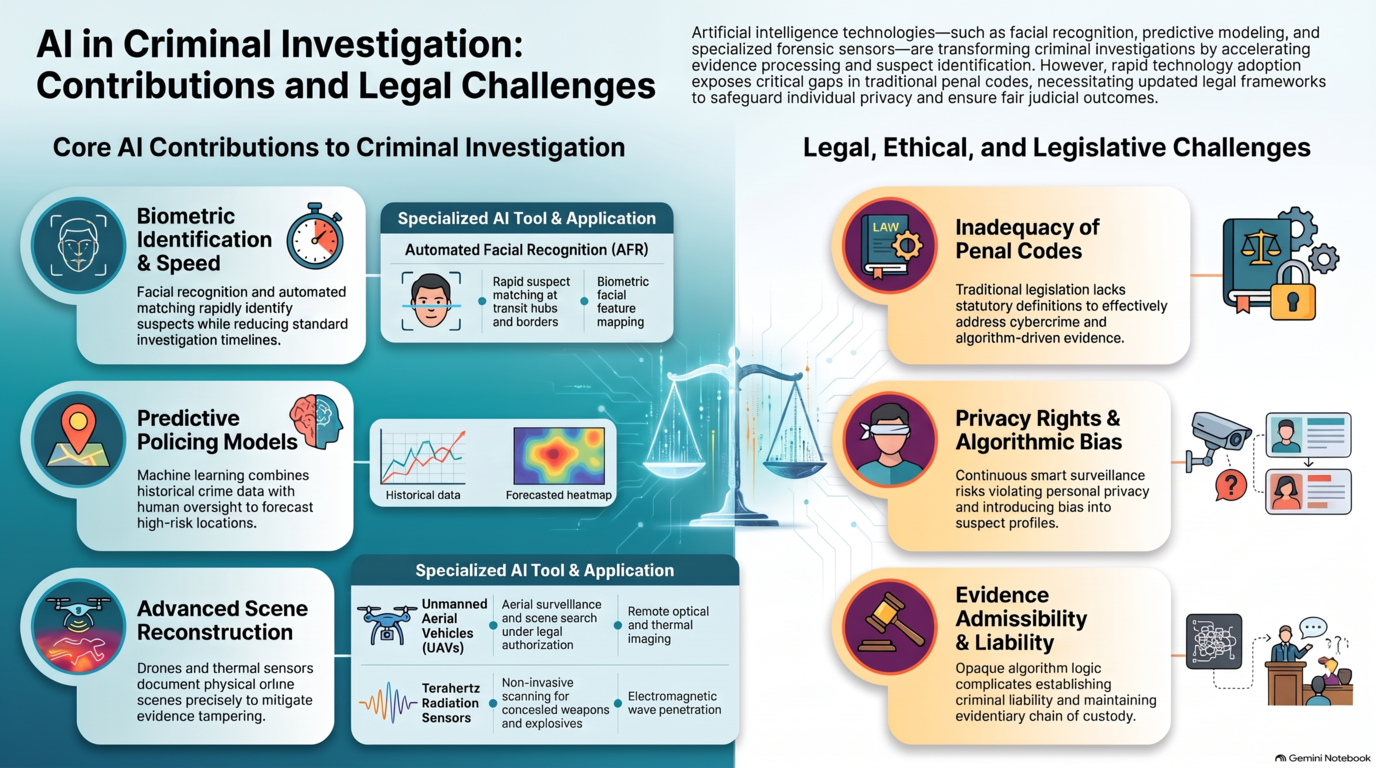
This study examines the contributions and legal challenges of artificial intelligence (AI) in criminal investigations using a descriptive-analytical methodology. The findings demonstrate that AI tools, such as facial recognition and behavioural analysis, significantly enhance the accurate identification of perpetrators and reduce conventional investigation times. These technologies enable precise crime-mapping and the linking of evidence to prior offences, elevating forensic inference and mitigating evidence tampering. Additionally, predictive policing strategies integrate AI with human capabilities to forecast criminal activity, support law enforcement, advance forensics, deliver efficient security services, and manage crises. The study highlights that traditional penal legislation is inadequate to address the continuous technological evolution of cybercrime, as existing laws were not designed for the information technology era. Examining the legislative framework of the Emirate of Dubai reveals an acceptance of unmanned aerial vehicles (UAVs) in investigations, coupled with stringent controls to balance security objectives with the protection of individual rights. This affirms the legitimacy of applying AI technologies in criminal investigations while underscoring the pressing need for a comprehensive regulatory framework to ensure legal compliance and the rigorous safeguarding of fundamental rights.
ملخص البحث
يهدف هذا البحث إلى التعرف على التطبيقات المعاصرة للذكاء الاصطناعي في البحث الجنائي، وإسهاماته وتحدياته القانونية. وقد استخدم الباحث المنهج الوصفي التحليلي لدراسة التطبيقات المعاصرة للذكاء الاصطناعي في البحث الجنائي، وتوصلت الدراسة إلى عدة نتائج، من أهمها أن استخدام أدوات الذكاء الاصطناعي، مثل التعرف على الوجوه وتحليل السلوكيات، يسهم في تحديد هوية الفاعلين الإجراميين بدقة عالية، وتقليل الوقت المستغرق في التحقيقات التقليدية. كما بينت الدراسة أن هذه التقنيات تمكّن المحققين من إنشاء خرائط دقيقة للجرائم وربط الأدلة بمسارات الجرائم السابقة، مما يرفع مستوى الاستدلال الجنائي ويحد من إمكانية التلاعب بالأدلة. علاوة على ذلك، تعمل استراتيجية الشرطة التنبؤية على دمج الذكاء الاصطناعي مع القدرات البشرية بهدف تعزيز فعالية العمل الأمني؛ إذ يُستعمل الذكاء الاصطناعي للتنبؤ بالجرائم ودعم العمليات الشرطية والتحقيقات العلمية، كما يسهم في تقديم الخدمات الأمنية للمواطنين بكفاءة، ويُستخدم كذلك في التخطيط وإدارة الأزمات والكوارث بشكل منظّم. ولم تعد النصوص الجزائية التقليدية كافية للتعامل مع الجرائم المعلوماتية، نظرًا إلى أن أساليب هذه الجرائم تتطور باستمرار من الناحية التكنولوجية، وأن القوانين التي وُضعت سابقًا لم تتضمن التصدي للتقنيات والابتكارات الجديدة التي أحدثتها تكنولوجيا المعلومات. بالإضافة إلى ذلك، يعكس الإطار التشريعي في إمارة دبي قبول المشرّع باستخدام الطائرات بدون طيار ضمن إجراءات التقصي والتحقيق، مع وضع ضوابط صارمة تضمن التوفيق بين تحقيق الأهداف الأمنية وحماية حقوق الأفراد وفق الأطر القانونية السارية. ويؤكد ذلك مشروعية تطبيق تقنيات الذكاء الاصطناعي، مع الحاجة الملحّة إلى إنشاء هيكل تنظيمي منظم يضمن الالتزام بالقوانين وصون الحقوق.
Downloads
References
Abdel Mageed, R. S. A. (2023). The use of artificial intelligence technologies and data analysis in crime detection.Journal of Legal and Economic Studies, 9(3), 215–258.
Abdel Mohsen, M. A. R., Al-Ghamdi, A. S., & Hassan, M. K. (2025). The role of artificial intelligence in combating crime using modern technological techniques: A comparative study. Journal of the Faculty of Sharia and Law, Assiut, 37(5), 112–159.
Abdel Rahman, A. (2021). Modern techniques in criminal analysis: The role of artificial intelligence in crime prediction. Dar Al-Fikr Al-Qanuni.
Abdel Rahman, O. (2018). Artificial intelligence and its risks. Dar Al-Kutub.
Abu Daher, K. T. (2024). Methods of analyzing and detecting drugs in biological samples. International Olive Tree University Journal, 22(22), 45–68.
Akerkar, R. (2019). Artificial intelligence for business. Springer. https://doi.org/10.1007/978-3-319-97436-1 DOI: https://doi.org/10.1007/978-3-319-97436-1
Ali, A. S. (2023). Artificial intelligence and its contemporary applications. Dar Al-Nahda Al-Arabiya.
Allay, A. R. (2023). Artificial intelligence in crime prediction and prevention. University of Sharjah Journal of Legal Sciences, 20(4), 180–214. https://doi.org/10.36394/jls.v20i4.4
Al-Loghani, A. A. (2018). Artificial intelligence in crime prevention and detection [Master’s thesis, Academy of Police Sciences, Sharjah]. Academy Repository.
Al-Oqbi, M. A. (2024). Mechanisms of international cooperation in combating transnational crimes. The Legal Journal, 22(4), 301–334.
Al-Othmani, M. K. (2021). Facial recognition technology and crime prevention at Arab airports. Security Policy Papers Journal, 2(1), 55–82. DOI: https://doi.org/10.26735/VGQW1724
Al-Shaer, S. A. Q. (2023a). The role of artificial intelligence in activating criminal investigation procedures in cybercrimes: A comparative study. Journal of Legal and Economic Research (Cairo), (2), 145–190.
Al-Shaer, S. A. Q. (2023b). The role of artificial intelligence in activating criminal investigation procedures in cybercrimes: A comparative study. Journal of Legal and Economic Research (Mansoura), 13(83), 1–48.https://doi.org/10.21608/mjle.2023.298115
Al-Shehri, A. J. M. (2024). Uses of artificial intelligence technologies in combating crime. Arab Journal for Scientific Publishing, (68), 88–110.
Anfais, A. A. M. A. (2024). The role of artificial intelligence in enhancing criminal justice: Challenges and opportunities in the Libyan context. International Journal of Science and Technology, 12(2), 77–98.
Bachner, J. (2013). Predictive policing: Preventing crime with data and analytics (Research Report). IBM Center for The Business of Government.
Bartneck, C. (2021). AI in law enforcement: Surveillance and crime prevention. Routledge.https://doi.org/10.4324/9781003125000
Bostrom, N. (2014). Superintelligence: Paths, dangers, strategies. Oxford University Press.
Carlson, T. (2022). Artificial intelligence in justice and public safety (White Paper). IJIS Institute.
Cheng, A., Liu, Y., & Zhao, H. (2025). Enhancing concealed object detection in active THz security images with adaptation YOLO. Scientific Reports, 15, Article 2735. https://doi.org/10.1038/s41598-025-02735-x DOI: https://doi.org/10.1038/s41598-024-81054-1
Farber, S. (2025). AI as a decision support tool in forensic image analysis: A pilot study on integrating large language models into crime scene investigation workflows. Journal of Forensic Sciences, 70(3), 410–425.https://doi.org/10.1111/1556-4029.15580 DOI: https://doi.org/10.1111/1556-4029.70035
González, R. S. (2024). Artificial intelligence applications for criminology and police sciences. International Journal of Humanities and Social Science, 14(2), 15–29. https://doi.org/10.30845/ijhss.v14n2p2 DOI: https://doi.org/10.30845/ijhss.v14p35
Hadi, I. Y. (2025). Contemporary use of artificial intelligence in criminal investigation. Ashur Journal of Legal and Political Sciences, (5), 189–218.
Hayward, K. J., & Maas, M. M. (2021). Artificial intelligence and crime: A primer for criminologists. Crime, Media, Culture: An International Journal, 17(2), 209–229. https://doi.org/10.1177/1741659020917434 DOI: https://doi.org/10.1177/1741659020917434
Hussain, K. (2018). Goal application and artificial intelligence. Journal Research International, 5(1), 12–24.
Ibrahim, K. M. (2025). The legal regulation of artificial intelligence. Dar Al-Fikr Al-Jami‘i.
Imam, H. M. (2025). A guide to artificial intelligence tools in legal practice: The professional reference for researchers and practitioners. Dar Al-Nahda Al-Arabiya.
Jeremy, P. (2019). Personal handguns act and review of various parts of the statutory act. Public Law Review, 30(4),211–230.
Kolesnikov, A. P. (2025). Artificial intelligence in crime prevention and investigation. Scientific Notes of Tavrida National V.I. Vernadsky University, Series: Juridical Sciences, 36(1), 142–148.
Maio, A. (2025). Artificial intelligence and crime: The dual role of AI in criminal activity and crime prevention.Universidade Nova de Lisboa Press.
McDaniel, J. L. M., & Pease, K. G. (Eds.). (2021). Predictive policing and artificial intelligence. Routledge.https://doi.org/10.4324/9780429279263 DOI: https://doi.org/10.4324/9780429265365
Mohamed, M. S. E. (2016). Police developments bulletin (Issue No. 6). Center for Future Foresight and Decision Support.
Mohamed, Y. A. M. (2025). Artificial intelligence and its role in criminal law. Iraqi University Journal, 73(5), 311–340.
Omar, H., & Abdel Haq, A. N. (2025). Artificial intelligence as a mechanism for criminal evidence. Daftar Al-Huqooq wa Al-Ulum Al-Jina’iya Journal, 5(1), 60–85.
Pagallo, U. (2013). The laws of robots: Crimes, contracts, and torts. Springer. https://doi.org/10.1007/978-94-007-6564-1 DOI: https://doi.org/10.1007/978-94-007-6564-1
Perry, W. L., McInnis, B., Price, C. C., Smith, S. C., & Hollywood, J. S. (2013). Predictive policing: The role of crime forecasting in law enforcement operations (Research Report RR-233-NIJ). RAND Corporation.https://doi.org/10.7249/RR233 DOI: https://doi.org/10.7249/RR233
Qandil, A. A. Q. (2021). Artificial intelligence in criminal investigation: Between contributions and challenges. Judicial Department Journal, (14), 89–120.
Rosenwald, M. S. (2014, April 11). Threats against Maryland gun dealers raise doubts about future of smart weapons.The Washington Post. https://www.washingtonpost.com/local/threats-against-maryland-gun-dealers-raise-doubts-about-future-of-smart-weapons/2014/04/11/9f7a783a-c0b0-11e3-b574-f8748871856a_story.html
Sayed, M. N. E. (2021). Security challenges of using artificial intelligence and digital systems in security work and ways to address them. Journal of Police Sciences, 29(2), 67–104.
Shenoy, S. U. (2023). Artificial intelligence-based techniques for crime scene reconstruction and investigation: An overview. Journal of Forensic Research, 14(4), Article 1000523. https://doi.org/10.35248/2157-7145.23.14.523
Sofian, S. (2025). Problems of using artificial intelligence in criminal investigations [Master’s thesis, Faculty of Law and Political Science, University of Ghardaia]. Institutional Repository.
Solove, D. J., & Schwartz, P. M. (2020). Information privacy law (7th ed.). Wolters Kluwer.
Sweif, M. (2019). Criminal liability of artificial intelligence technologies. Journal of Jurisprudential and Legal Research, 48(48), 512–549.
Tolbaru, C.-E. (2025). Artificial intelligence: A vector for crime and a tool for carrying out criminal justice. Athens Journal of Law, 11(4), 385–404. https://doi.org/10.30958/ajl.11-4-3 DOI: https://doi.org/10.30958/ajl.11-4-5
Wolbers, H. (2025). Artificial intelligence and child sexual abuse: A rapid evidence assessment (Research Report No.24). Australian Institute of Criminology. https://doi.org/10.52922/rr78129 DOI: https://doi.org/10.52922/ti77802
Yadav, S. (2022). Artificial intelligence: An advanced evolution in forensic and criminal investigation. International Journal of Law Management & Humanities, 5(3), 1438–1448. https://doi.org/10.10000/IJLMH.113214
Zerouki, R. (2020). The role of artificial intelligence in improving the quality of higher education. Arab Journal of Specific Education, (12), 45–66.
Downloads
Published
Issue
Section
License
Copyright (c) 2026 Ahmed Lotfi Ali Salam

This work is licensed under a Creative Commons Attribution-NonCommercial 4.0 International License.