Maqasid Al-Shariah (The Higher Objectives of Islamic Law) of Judiciary: Exploring The Malaysian Syariah Legal Perspective
DOI:
https://doi.org/10.55265/lpsjournal.v5i1.143Keywords:
Islamic law of judiciary, Malaysian Syariah law, Syariah higher objectivesAbstract
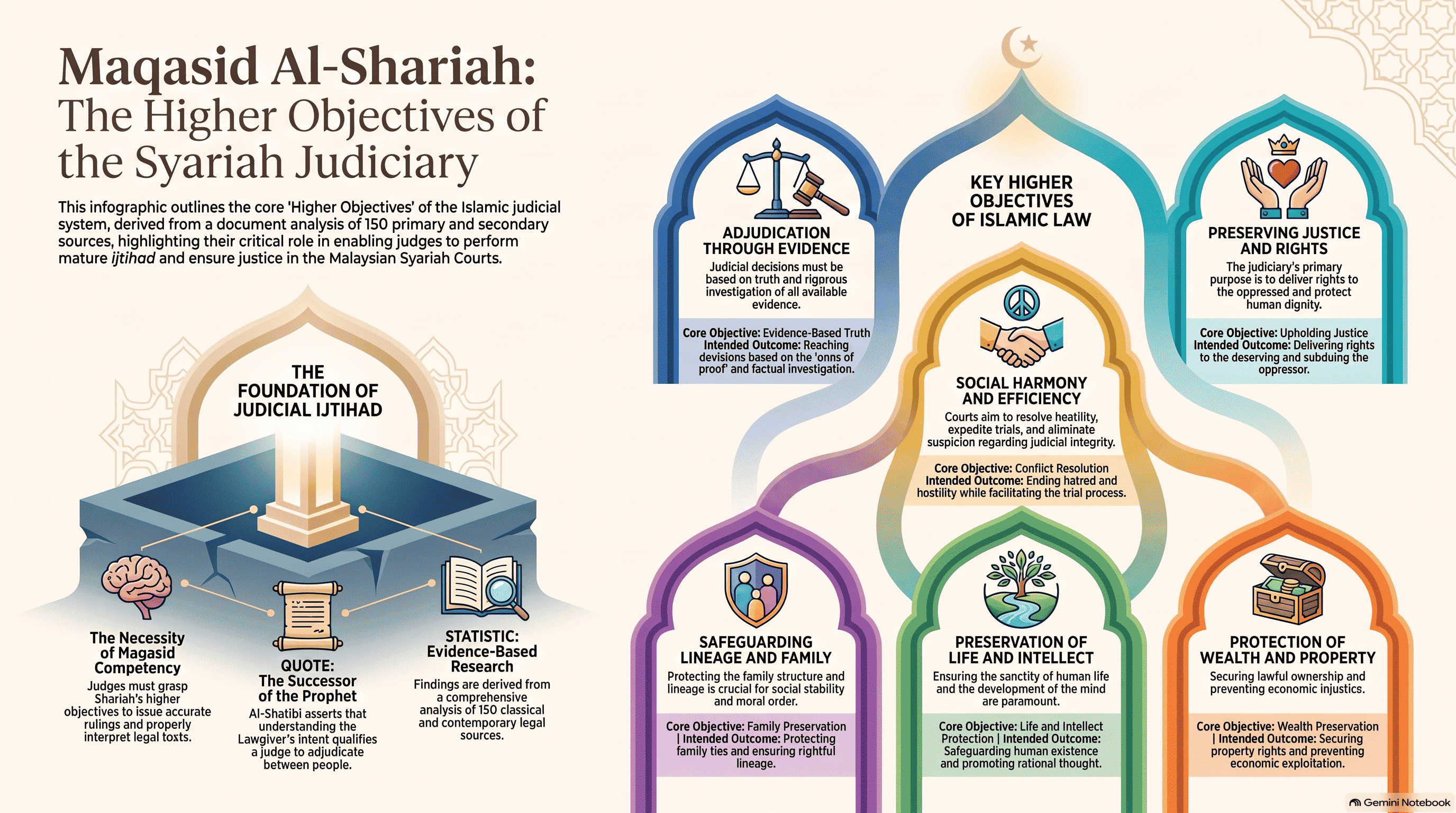
The objectives of Islamic law are important in decision-making because they promote mature and analyse ijtihad. Whoever grasps the essential principle and gains skill in it has substantial knowledge. Understanding Islamic law’s objectives also helped judges and lawyers properly examine Islamic legal documents and draw correct findings. The goal of this qualitative study was to find instances of Maqasid Syariah in Islamic law relating to the judiciary in general, as well as Syariah law in Malaysia. This study also sought to address the question, “What are the higher purposes of Islamic judicial law?” This research used Glenn A. Bowen’s document analysis approach. The findings of this study revealed that Islamic judicial law has distinct objectives. This study identified six key aims in Islamic judicial law by referring to 150 primary and secondary sources. Each of the indicated higher purposes, according to the researchers’ findings, is obtained from authority acquired from the Qur'an, hadith, or athār in regard to the Islamic judicial system. The researchers discovered that all six of these higher objectives are interconnected and complimentary. In truth, there are numerous more higher objectives in Islamic judicial law that have been acknowledged and analyzed by earlier and contemporary scholars, but which were not disclosed and explored in this study. Researchers would want to provide some opportunity for other researchers to further their inquiries into this area. It is sufficient for researchers to publish this work as part of an academic contribution on the issue of higher goals of Islamic law, especially those related to Islamic judicial law. The study of higher purposes in Islamic law, particularly Islamic judicial law, is expected to grow in the future.
Downloads
References
Abdullah, A. B. (2020). Penggunaan Maqasid Syariah dalam Hujah di Mahkamah Syariah: Satu Tinjauan Awal. In M. A. M. Adil, A. H. Buang, & A. B. Abdullah (Eds.), Mahkamah Syariah di Malaysia - Menelusuri Cabaran Melestari Hadapan (1st ed., pp. 455-467). Selangor: Penerbit UiTM.
Abū al-Maʿālī al-Juwaynī, A. M. A. (1997). al-Burhānu fī Usūli al-Fiqhi (S. Muhammad Ed. 1st ed. Vol. 1). Beirut: Dar al-Kutub al-‘Ilmiah.
Abu al-Walīd al-Bājī, S. K. (1914). al-Muntaqā Sharḥ al-Muwaṭṭa' (1st ed. Vol. 5). Egypt: Maṭbaʿah al-Saʿadah.
Abu Dāud, S. A. A. (2013). Sunan Abī Dāwud (Y. Hasan, I. Dalli, & I. al-Tiyar Eds. 1 ed.). Damsyik: Mu'asasat al-Risalah.
Abu Yaʿlā al-Farrā', M. A. H. (2000). al-Aḥkām al-Sulṭāniyyah (M. H. al-Faqi Ed. 2nd ed.). Beirut: Dar al-Kutub al-Ilmiah.
Ahmad @ Ahmad Zukni bin Johari lwn. Rosnah binti Esahak (2009), No. 14000-002-0015-2008, 28(2) JH 163 (Syariah Court of Appeal, Shah Alam).
Aḥmad, A. M. (2001a). Musnad al-Imām Aḥmad bin Ḥanbal (M. N. al-'Irqisusi, I. al-Zaybaq, & Ā. Murshid Eds. 1st ed. Vol. 28). Beirut: Mu'asasah al-Risalah.
Aḥmad, A. M. (2001b). Musnad al-Imām Aḥmad bin Ḥanbal (S. a. al-Arnāwuṭ, M. N. al-'Irqisusi, & M. R. al-'Irqisusi Eds. 1st ed. Vol. 32). Beirut: Mu'asasah al-Risalah.
Aḥmad, A. M. (2001c). Musnad al-Imām Aḥmad bin Ḥanbal (S. a. al-Arnāwuṭ & Ā. Murshid Eds. 1st ed. Vol. 2). Beirut: Mu'asasah al-Risalah.
Aḥmad, A. M. (2001d). Musnad al-Imām Aḥmad bin Ḥanbal (S. a. al-Arnāwuṭ, M. N. al-'Irqisusi, & I. al-Zaybaq Eds. 1st ed. Vol. 25). Beirut: Mu'asasah al-Risalah.
Aḥmad, A. M. (2001e). Musnad al-Imām Aḥmad bin Ḥanbal (S. a. al-Arnāwuṭ, M. N. al-'Irqisusi, I. al-Zaibaq, & M. A. al-Khan Eds. 1 ed. Vol. 41). Beirut: Mu'asasah al-Risalah.
Aḥmad, A. M. (2001f). Musnad al-Imām Aḥmad bin Ḥanbal (S. a. al-Arnāwuṭ & Ā. Murshid Eds. 1st ed. Vol. 3). Beirut: Mu'asasah al-Risalah.
Ahmad, W. N. A. W., Ismail, A., & Mokhtar, A. I. (2021). Perspektif Maqasid Syariah dalam Memelihara Institusi Keluarga. Jurnal Islam dan Masyarakat Kontemporari, 22(3), 17-28. doi:10.37231/jimk.2021.22.3.584
Ahmed, J. U. (2010). Documentary research method: New dimensions. Indus Journal of Management and Social Sciences, 4(1), 1-14.
al-Albāni, M. N. (1985). Irwā' al-Ghalīl fī Takhrīj Aḥādīth Manār al-Sabīl (Z. al-Shawish Ed. 2nd ed. Vol. 8). Beirut: al-Maktab al-Islami.
al-Baghawī, H. M. (1983). Sharḥu al-Sunnati (S. a.-A. M. Z. al-Shāwish Ed. 2nd ed. Vol. 10). Damascus: al-Maktab al-Islami.
al-Baihaqī, A. A. H. (1991). Maʿrifat al-Sunan wa al-Athār (A. M. t. A. Qal'aji Ed. 1st ed. Vol. 14). Beirut: Dar Qutaibah.
al-Baihaqī, A. A. H. (2003). al-Sunan al-Kubrā (M. A. Q. Atha Ed. 3rd ed. Vol. 10). Beirut: Dar al-Kutub al-Ilmiah.
al-Bakri, Z. M. (2014). Maqasid al-Syariah: Satu Pengenalan Umum (1st ed.). Nilai: Pustaka Cahaya Kasturi.
al-Bukhārī, M. I. (2018). al-Jāmi’ al-Ṣaḥīḥ al-Musnad al-Mukhtaṣar min Umūri Rasūlillahi ṣallallahu ʿalaihi wasallam wa Sunanihi wa Ayyāmihi. (I. Dalli, I. al-Tiyar, & Y. Hasan Eds. 3rd ed.). Damascus: Resalah Publishers.
al-Damīrī, M. M. (2004). al-Najmu al-Wahhāj fī Sharḥ al-Minhāj (1st ed. Vol. 10). Jedah: Dar al-Minhaj.
al-Dāruquṭnī, A. a.-Ḥ. A. (2004). Sunan al-Dāruquṭnī. Beirut: Muassasah al-Risālah.
al-Ḥadād, A. B. A. (2006). al-Jawhar an-Nayyirah Sharḥ Mukhtaṣar al-Qudūrī fī Furūʿ al-Ḥanafiyyah (I. Qablan Ed. 1st ed. Vol. 2). Beirut: Dar al-Kutub al-Ilmiah.
al-Hamad, N. A. (2005). al-Kutubu al-Mu'allafatu fī al-Qaḍā'i wat-Tawsīqi wan-Nawāzil. Majallah al-ʿAdl, 25, 1-29.
al-ʿIzz Ibni Abdissalam, A. A. A. S. (2020). Qawāʿidu al-Aḥkāmi fī Iṣlāḥi al-Anāmi (N. K. Hammad & O. J. Dumayriyyah Eds. 6th ed. Vol. 2). Damascus: Dar al-Qalam.
al-Khaṭīb al-Shirbīnī, M. A. (2000). Mughnī al-Muḥtāji ilā Ma’rifati Ma'ānī Alfāẓi al-Minhāji (A. M. Mu'awwad & A. A. A. Mawjud Eds. 2nd ed. Vol. 6). Beirut Dar al-Kutub al-Ilmiah.
al-Marghinānī, A. b. A. B. (1996). al-Hidāyah Sharḥ Bidāyah al-Mubtadī (N. i. A. N. Muhammad Ed. 1st ed. Vol. 5). Karachi: Idarah al-Quran wa al-Ulum al-Islamiyyah.
al-Māwardī, A. M. (1971). Adabu al-Qāḍī (M. H. al-Sarhan Ed. Vol. 1). Baghdad: Matba'ah al-Irshad.
al-Māwardī, A. M. (2006). al-Aḥkām al-Sulṭāniyyah (A. Jad Ed. 1st ed.). Cairo: Dar al-Hadith.
al-Mīdānī, A. G. (2014). al-Lubāb fī Sharḥi al-Kitāb Sharḥ li-Mukhtaṣar al-Qudūrī fī al-Fiqhi al-Ḥanafi (S. i. Bakdash Ed. 2nd ed. Vol. 5). Beirut: Dar al-Basha'ir.
al-Minhājī al-Asyūṭī, M. A. (2011). Jawāhirul ʿUqūdi wa-Muʿīnul Quḍāti wal-Muwaqqiʿīni wasyh-Syuhūdi (H. Abbas Ed. 1st ed. Vol. 4). Mecca: al-Maktabah al-Makkiyah.
al-Nasā'ī, A. S. (2014). al-Sunan al-Nasā'ī (I. al-Tiyar, Y. Hasan, & I. Dalli Eds. 1st ed.). Damascus: Muasasat al-Risalah.
al-Nawawī, Y. S. (1991). Rauḍah al-Ṭālibīn wa ʿUmdah al-Muftīn (Z. al-Shawish Ed. 3rd ed. Vol. 11). Beirut: al-Maktab al-Islami.
al-Nawawī, Y. S. (2010a). al-Minhāj Sharaḥ Ṣaḥīḥ Muslim bin al-Ḥajjāj (M. Maraʿī Ed. 1st ed. Vol. 15). Damascus: Dar al-Fayha'.
al-Nawawī, Y. S. (2010b). al-Minhāju Sharḥu Ṣaḥīḥi Muslim bin al-Ḥajjāj (M. Maraʿī Ed. 1st ed. Vol. 12). Damascus: Dar al-Fayha'.
al-Nubāhī, A. A. (1995). al-Marqabatu al-ʿUlyā fīman Yastaḥiqqu al-Qaḍā'a wal-Futyā (M. Q. Tawil Ed. 1st ed.). Beirut: Dar al-Kutub al-Ilmiah.
al-Qaraḍāwī, Y. (1998). al-Ijtihād al-Muʿāṣir Bayna al-Inḍibāṭ wal-Infirāṭ (2nd ed.). Beirut: al-Maktab al-Islami.
al-Qaraḍāwī, Y. (2008). Dirāsatu Fī Fiqhi Maqāṣidi al-Sharīʿati: Bayna al-Maqāṣidi al-Kuliyyati wan-Nuṣūṣu al-Juz’iyyati (3rd ed.). Cairo: Dar al-Shuruq.
al-Qaraḍāwī, Y. (2013a). Introduction to the Study of Islamic Law (A. Ismail, M. H. Rahman, & A. A. M. Arshad, Trans. 1st ed.). Kuala Lumpur: IBFIM.
al-Qaraḍāwī, Y. (2013b). Islamic Moderation and Renewal (H. A. Ibrahim, H. A. R. El-Nagar, & I. S. El-Hassan, Trans. M. A. A. R. al-Aidrus Ed. 1st ed.). Kuala Lumpur: International Institute of Islamic Thought and Civilization (INSTAC).
al-Qarāfi, A. I. (1994). adh-Dhakhīrah (M. B. Khabzah Ed. 1st ed. Vol. 10). Beirut: Dar al-Gharb al-Islami.
al-Raysūnī, A. (2009). Muḥāḍarātu fī Maqāṣidi al-Sharīʿati (1st ed.). Cairo: Dar al-Salam.
al-Raysūnī, A. (2010). Madkhal ilā Maqāṣidi al-Sharīʿati (1st ed.). Cairo: Dar al-Kalimah.
al-Raysūnī, A. (2014). al-Fikru al-Maqāṣidī: Qawāʿiduhu wa-Fawāiduhu (3rd ed.). Cairo: Dar al-Kalimah.
al-Raysūnī, A. (2016). al-Dharīʿatu ilā Maqāṣidi al-Sharīʿati (1st ed.). Cairo: Dar al-Kalimah.
al-Ṣadru al-Syahīd, U. A. A. (1977). Sharḥu Adabi al-Qāḍī lil-Khaṣṣāfi (M. K. al-Sarhan Ed. 1st ed. Vol. 1). Baghdad: Matba'ah al-Irsyad.
al-Sarkhasī, M. A. (1993). al-Mabsūṭ (Vol. 16). Beirut: Dar al-Ma'rifah.
al-Shāfiʿī, M. I. (2004a). Musnad al-Imām ash-Shāfiʿī (M. Y. al-Fahl Ed. 1st ed. Vol. 3). Kuwait: Syirkah Gheras.
al-Shāfiʿī, M. I. (2004b). Musnad al-Imām ash-Shāfiʿī (M. Y. al-Fahl Ed. 1st ed. Vol. 4). Kuwait: Syirkah Gheras.
al-Shāṭibī, I. M. (2017a). al-Muwāfaqāt (A. H. A. Said Ed. 1st ed. Vol. 5). Fas: Manshūrāt al-Bashīr Binʻaṭiyyah.
al-Shāṭibī, I. M. (2017b). al-Muwāfaqāt (A. H. A. Said Ed. 1st ed. Vol. 3). Fas: Manshūrāt al-Bashīr Binʻaṭiyyah.
al-Shāṭibī, I. M. (2017c). al-Muwāfaqāt (A. H. A. Said Ed. 1st ed. Vol. 2). Fas: Manshūrāt al-Bashīr Binʻaṭiyyah.
al-Shirwānī, A. H., & al-ʿAbbādī, A. Q. (1983). Ḥawāshī al-Shirwānī wa Ibnu Qāsim al-ʿIbadi ʿala Tuḥfah al-Muḥtāj bi-Sharh al-Minhāj (1st ed. Vol. 10). Egypt: al-Maktabah al-Tijariyah al-Kubra.
al-Ṭarābulusi, A. K. (2018). Muʿīnu al-Ḥukkāmi fīmā Yataraddadu Bayna al-Khaṣmaini mina al-Aḥkāmi (O. J. Dumayriyyah Ed. 1st ed. Vol. 1). Damascus: Dar al-Qalam.
al-Tirmidhī, M. I. (2011). Sunan al-Tirmidhī (I. Dalli, I. al-Tiyar, & Y. Hasan Eds. 1st ed.). Damsyik: Mu'asasat al-Risalah.
al-Tusūlī, A. A. S. (1998). al-Bahjah fī Sharḥ al-Tuḥfah ʿalā al-Urjuzah al-Musammāh bi-Tuḥfat al-Ḥukkām (M. A. Q. Shahin Ed. 1st ed. Vol. 1). Beirut: Dar al-Kutub al-Ilmiah.
al-Umar, M. R. (2008). Uṣūlu al-Taḥqīqi al-Jinā'ī fī al-Syarīʿati al-Islāmiyyati: Dirāsat al-Fiqhiyyah Muqāranah (1st ed.). Damascus: Dar al-Nawadir.
al-Zarqā, M. A. (2014). Introduction to Islamic Jurisprudence (M. A. al-Muhsin, Y. T. Muritala, I. M. Salim, S. Hussain, & S. Nadwi, Trans. 1st ed.). Kuala Lumpur: IBFIM.
al-Zurqānī, A. B. Y. (2015). Sharḥu al-Zurqānī ʿalā Muwaṭṭā' al-Imām Mālik (M. F. A. Baqi Ed. 1st ed. Vol. 4). Cairo: Dar al-Hadith.
Ali Jumʿah, M. (1996). al-Madkhal (1st ed.). Cairo: al-Maʿhad al-ʿAlami lil-Fikri al-Islami.
Ali Jumʿah, M. (2009). aṭ-Ṭarīqu ilā at-Turāthi al-Islāmī - Muqaddimāt Maʿrifiyyah wa-Madākhil Manhajiyyah (4th ed.). Cairo: Nahdah Misr.
Ali Jumʿah, M. (2017). al-Kutubu al-Mukawwinatu lil-Fikri al-Islāmiyyi as-Sunniyyi (1st ed.). Cairo: Dar al-Salih.
Anwar, S. F. M. (2019, 22 October). Terap maqasid syariah dalam perundangan Islam. BH Online. Retrieved from https://www.bharian.com.my/berita/nasional/2019/10/620374/terap-maqasid-syariah-dalam-perundangan-islam
Aziz, S. A. (2016). Maqasid al-Syariah dalam Perlembagaan Persekutuan: Satu Perbahasan Awal. Kanun: Jurnal Undang-undang Malaysia, 28(2), 278-312.
Azungah, T. (2018). Qualitative research: deductive and inductive approaches to data analysis. Qualitative Research Journal, 18(4), 383-400. doi:10.1108/QRJ-D-18-00035
Badruddin al-Ghazzī, M. M. (2009). Ad-Durru an-Naḍīdu fī Adabi al-Mufīdi wal-Mustafīdi (A. Y. q. N. a. K. al-Misri Ed. 1st ed.). Giza: Maktabah at-Tawʿiyyah al-Islamiyyah.
Bengtsson, M. (2016). How to plan and perform a qualitative study using content analysis. NursingPlus Open, 2, 8-14. doi:10.1016/j.npls.2016.01.001
Bowen, G. A. (2009). Document Analysis as a Qualitative Research Method. Qualitative Research Journal, 9(2), 27-40. doi:10.3316/QRJ0902027
Bryman, A. (2012). Social Research Methods. Oxford: Oxford University Press.
Bryman, A., & Bell, E. (2015). Business Research Methods. Oxford: Oxford University Press.
Castleberry, A., & Nolen, A. (2018). Thematic analysis of qualitative research data: Is it as easy as it sounds? Currents in Pharmacy Teaching and Learning, 10(6), 807-815. doi:10.1016/j.cptl.2018.03.019
Chinedu, C. C., & Mohamed, W. A. W. (2017). A document analysis of the visibility of sustainability in TVE teacher education programme: The case of a Malaysian HEI. Pertanika Journal of Social Sciences and Humanities, 25, 201-215.
Dahalan, H. M., Junaidi, M. A. H., Rahman, M. R. A., Dahlan, N. K., & Yahya, M. A. (2021). Prosedur Tatatertib Peguam Syarie di Mahkamah Syariah: Analisis dari Perspektif Prinsip Syariah. Islāmiyyāt, 43(Special), 153-163.
Daud, A. M. A. (2011). Uṣūlu al-Muḥākamāti al-Sharʿiyyati (2nd ed. Vol. 1). Amman: Dar al-Thaqafah.
Department of Syariah Judiciary Malaysia. (2001a). Arahan Amalan No. 1 Tahun 2001 - Kod Etika Hakim Syarie. (JKSM/100-24/5). Putrajaya: Department of Syariah Judiciary Malaysia Retrieved from http://bsktransit.jksm.gov.my/aa/uploads/012001.pdf.
Department of Syariah Judiciary Malaysia. (2001b). Arahan Amalan No. 4 Tahun 2001 - Penangguhan Kes. (JKSM/100-24/5). Putrajaya: Department of Syariah Judiciary Malaysia Retrieved from http://www.esyariah.gov.my/images/esyariah/Document/ArahanAmalan/2001/Arahan%204(edit).PDF.
Department of Syariah Judiciary Malaysia. (2001c). Arahan Amalan No. 5 Tahun 2001 - Penyelarasan Masa Bersidang Mahkamah. (JKSM/100-24/5). Putrajaya: Department of Syariah Judiciary Malaysia Retrieved from http://www.esyariah.gov.my/images/esyariah/Document/ArahanAmalan/2001/Arahan%205(edit).PDF.
Department of Syariah Judiciary Malaysia. (2002a). Arahan Amalan No. 3 Tahun 2002 - Pemakaian Sulh. (JKSM/100-24/5 (14)). Putrajaya: Department of Syariah Judiciary Malaysia Retrieved from http://www.esyariah.gov.my/images/esyariah/Document/ArahanAmalan/2002/Arahan%203(edit).PDF.
Department of Syariah Judiciary Malaysia. (2002b). Arahan Amalan No. 4 Tahun 2002 - Etika Peguam Syarie. (JKSM/100-24/5 (15)). Putrajaya: Department of Syariah Judiciary Malaysia Retrieved from http://bsktransit.jksm.gov.my/aa/uploads/042002.pdf.
Department of Syariah Judiciary Malaysia. (2004). Arahan Amalan No. 3 Tahun 2004 - Penangguhan Kes Atas Alasan Cuti Sakit. (JKSM/100-24/5 (41)). Putrajaya: Department of Syariah Judiciary Malaysia Retrieved from http://www.esyariah.gov.my/images/esyariah/Document/ArahanAmalan/2004/Arahan%203.pdf.
Department of Syariah Judiciary Malaysia. (2013). Arahan Amalan No. 2 Tahun 2013 - Had Masa Sebutan dan Perbicaraan. (JKSM.600-1/2/4(33)). Putrajaya: Department of Syariah Judiciary Malaysia Retrieved from http://syariah.terengganu.gov.my/files/022013.pdf.
Elo, S., Kääriäinen, M., Kanste, O., Pölkki, T., Utriainen, K., & Kyngäs, H. (2014). Qualitative Content Analysis. SAGE Open, 4(1), 2158244014522633. doi:doi:10.1177/2158244014522633
Elo, S., & Kyngäs, H. (2008). The qualitative content analysis process. Journal of advanced nursing, 62(1), 107-115. doi:https://doi.org/10.1111/j.1365-2648.2007.04569.x
Erlingsson, C., & Brysiewicz, P. (2017). A hands-on guide to doing content analysis. African Journal of Emergency Medicine, 7(3), 93-99. doi:10.1016/j.afjem.2017.08.001
Faridah bt Ahmad v. Hairunajib bin Mohd Mansor (2017), No. 10003-014-1587-2015, 4 ShLR 27 (Syariah Subordinate Court, Klang).
Glaser, B. G., & Strauss, A. L. (2006). The Discovery of Grounded Theory: Strategies for Qualitative Research. New Brunswick: Aldine Transaction.
Halim, W. M. A. W., Zainal, A. N. A., & Abidin, N. M. B. Z. (2018). Application of Maqasid Syariah in The Act 355 Amendment Proposal (Criminal Jurisdiction): An Analysis Study. Jurnal Intelek, 13(2), 47-56.
Hassim, M. H., & Sholehuddin, N. (2019). Kerangka Maqasid Al-Syariah: Peranan Pegawai Penguatkuasa Agama Dalam Menguatkuasakan Kesalahan Berkaitan Tatasusila. Journal of Muwafaqat, 2(1), 84-98.
Humaysh, A. H. (2007). Qaḍāyā Fiqhiyyatu Muʿaṣirati. Sharjah: University of Sharjah.
Ibnu ‘Ashūr, M. A. T. (2016). Maqāṣidu al-Syarīʿati al-Islāmiyyati (M. al-Zuḥaylī Ed. 1st ed.). Damascus: Dar al-Qalam.
Ibnu Abd al-Bar, Y. A. (2000). al-Istidhkār (S. M. Atha & M. A. Mu'awwad Eds. 1st ed. Vol. 7). Beirut: Dar al-Kutub al-Ilmiah.
Ibnu Abi al-Dam, I. A. (1982). Adābu al-Qaḍā'i (M. al-Zuḥayli Ed. 2nd ed.). Damascus: Dar al-Fikr.
Ibnu al-Humām, M. A. W. (2003). Sharḥu Fatḥu al-Qadīri ʿalā al-Hidāyati Sharḥu Bidāyatu al-Mubtadī (A. R. G. al-Mahdi Ed. 1st ed. Vol. 7). Beirut: Dar al-Kutub al-Ilmiah.
Ibnu al-Mundhir, M. I. (1999). al-Ijmāʿ (A. M. Hanif Ed. 2nd ed.). Amman: Maktabah al-Furqan.
Ibnu al-Qāṣ, A. A. A. (1989). Adabu al-Qāḍī (H. K. al-Jabouri Ed. 1st ed. Vol. 1). Taif: Maktabah al-Sadiq.
Ibnu al-Qayyim al-Jawziyyah, M. A. B. (2019a). aṭ-Ṭuruqu al-Ḥukmiyyatu fī al-Siyāsati al-Sharʿiyyati (N. A. al-Hamad Ed. 1st ed. Vol. 1). Beirut: Dar Ibnu Hazm.
Ibnu al-Qayyim al-Jawziyyah, M. A. B. (2019b). Iʿlāmu al-Muwaqqiʿīna ʿan Rabbi al-ʿAlamīna (M. U. Shams Ed. 1st ed. Vol. 3). Beirut: Dar Ibnu al-Jawzi.
Ibnu al-Simnānī, A. M. (1984). Rawḍatu al-Quḍāti wa-Ṭarīqu an-Najāti (S. al-Nahi Ed. 2nd ed. Vol. 1). Amman: Dar al-Furqan.
Ibnu al-Turkumānī, A. O. (1935). al-Jawharu an-Naqīyyu fī Raddi ʿalā Bayhaqī (1st ed. Vol. 8). Hyderabad: Matba'ah Majlis Daʾirat al-Maʿarif al-Othmaniah.
Ibnu Daqīq al-ʿId, M. A. (1987). Iḥkāmu al-Aḥkāmi Sharḥu ʿUmdatu al-Aḥkāmi (A. M. Syakir Ed. 2nd ed. Vol. 2). Beirut: Alim al-Kutub.
Ibnu Farḥūn, I. A. (2016). Tabṣiratu al-Ḥukkāmi fī Usūli al-Aqdiyati wa Manāhiji al-Aḥkāmi (O. J. Dumayriyyah Ed. 1st ed. Vol. 1). Damascus: Dar al-Qalam.
Ibnu Hajar al-Haitamī, A. M. (2016). Tuḥfatu al-Muḥtāji bi-Sharḥi al-Minhāji (S. M. al-Sannari Ed. Vol. 4). Kaherah: Dar al-Hadith.
Ibnu Hubairah, Y. H. (2002). Ikhtilāfu al-Aimmati al-ʿUlamā'i (Y. Ahmad Ed. 1st ed.). Beirut: Dar al-Kutub al-Ilmiah.
Ibnu Jamāʿah al-Kinānī, M. I. (2012). Tadhkiratu al-Sāmiʿi wal-Mutakallimi fī Adabi al-ʿĀlimi wal-Mutaʿallimi (M. M. al-ʿAjmiyyi Ed. 3rd ed.). Beirut: Dar al-Basha'ir al-Islamiyyah.
Ibnu Majah, M. Y. (2009). Sunan Ibnu Mājah (I. al-Tiyar, Y. Hasan, & I. Dalli Eds. 1 ed.). Damascus: Mu'asasat al-Risalah.
Ibnu Qudāmah, A. A. (1997). al-Mughnī (A. A. M. al-Turki & A. F. M. al-Halwi Eds. 3rd ed. Vol. 14). Riyad: Dar Alimul Kutub.
Ibnu Rāshid al-Qafṣī, M. A. (2007). Lubāb al-Lubāb fī Bayāni Ma Taḍamanatahu Abwābu al-Kitābi minal-Arkāni wal-Syurūṭi wal-Mawāniʿi wal-Asbābi (M. al-Madnini & A. H. Tahir Eds. 1st ed. Vol. 1). Dubai: Research House for Islamic Studies and Heritage Revival.
Ibnu Rushd al-Ḥafīd, M. A. (1994). Bidāyatu al-Mujtahidi wa Nihāyatu al-Muqtaṣidi (M. S. H. Hallaq Ed. 1st ed. Vol. 4). Cairo: Maktabah Ibnu Taimiyyah.
Ibnu Taimiyyah, A. A. H. (1995). Majmū' al-Fatāwā (A. R. Muhammad Ed. Vol. 35). Saudi Arabia: Majma al-Malik Fahad litiba'ah al-Mushaf al-Sharif.
Ismail, U. (2013). Dawru al-Ijtihādi wat-Taqlīdi fī Niẓāmi al-Qaḍā'i: Dirāsah Tārīkhiyyah Taḥlīliyyah (1st ed.). Damascus: Dar Ibn Kathir.
Jalāluddin al-Suyūṭī, A. R. A. B. (2020). Ar-Raddu ʿalā man Akhlada ilā al-Arḍi wa-Jahila annal Ijtihāda fī Kulli ʿAsri Farḍun. In A. A. A. S. al-Dāghistānī (Ed.), Arbaʿa Rasā'il fī al-Ijtihādi wat-Tajdīdi lil-Imāmi Jalāluddin as-Suyūṭī (1st ed., pp. 135-259). Saudi Arabia: Dar Madarij.
Joffe, H., & Yardley, L. (2004). Content and Thematic Analysis. In Research methods for clinical and health psychology (pp. 56-68). California: Sage Publications.
Juliah Abdullah v. Omar Charles Abdullah (2011), No. 14200-023-0311-2006, 1 CLJ (Sya) 307 (Syariah High Court, Federal Territory of Kuala Lumpur).
Khunain, A. M. (2003). Tawṣīfu al-Aqḍiyati fī al-Sharīʿati al-Islamiyyati (1st ed. Vol. 1). Riyadh: Dar Ibnu Farhun.
Khunain, A. M. (2010). al-Madkhal ilā Fiqhi al-Murāfaʿāti (2nd ed.). Riyadh: Dar Ibn Farhoon.
Khunain, A. M. (2018). Tanzīlu al-Aḥkāmi ʿala al-Waqāiʿi al-Qaḍā'iyyati wal-Fatwiyyati (1st ed.). Riyadh: Markaz al-Tamyiz al-Bahthi fi Fiqhi al-Qadaya al-Mu'asarah Jami'ah al-Imam Muhammad bin Su'ud al-Islamiyyah.
Krippendorff, K. (2004). Content Analysis: An Introduction to Its Methodology (2nd ed.). Thousand Oaks: SAGE Publications, Inc.
Lawson, L. V. (2018). Documentary analysis as an assessment tool. Public Health Nursing, 35(6), 563-567. doi: https://doi.org/10.1111/phn.12520
Majid, M. Z. A. (2015). Pelaksanaan Undang-undang Jenayah Syariah di Malaysia ditinjau dari Perspektif Maqasid Syariah. In A. W. Dusuki (Ed.), Pelaksanaan Hudud di Malaysia: Satu Analisis (1st ed., pp. 23-32). Kuala Lumpur: Yayasan Dakwah Islamiah Malaysia (YADIM).
Malik, A. (2013). al-Muwaṭṭa' (K. H. Ali Ed. 1st ed.). Beirut: Mu'asasat al-Risalah.
Mayanja, S. J. (2017). Circumstantial Evidence and Its Admissibility in Criminal Proceedings: A Comparative Analysis of the Common Law and Islamic Law Systems. Journal of Law, Policy and Globalization, 67, 26-33.
Merriam, S. B. (2009). Qualitative Research: A Guide to Design and Implementation (2nd ed.). San Francisco: John Wiley & Sons, Inc.
Muhammad al-Zuḥaylī, M. (2002). al-Tanẓīmu al-Qaḍāʾī fī al-Fiqhi al-Islāmī: Dirāsah Muqāranah bayna al-Madhāhibi al-Fiqhiyyati wal-Anẓimati wal-Qawānīni fī Sūriyati wal-Saʿūdiyyati wal-Imārāt al-ʿArabiyyati (2nd ed.). Damascus: Dar al-Fikr.
Muhammad al-Zuḥaylī, M. (2010). Marjiʿ al-ʿUlūmu al-Islāmiyyatu (1st ed.). Damascus: Dar al-Mustafa.
Muhammad al-Zuḥaylī, M. (2016). Tārīkhu al-Qaḍā'i fī al-Islāmi (3rd ed.). Beirut: Dar al-Fikr al-Mu'asir.
Muhammad, D. (2001). Tugas Kehakiman Dalam Mahkamah: Pengalaman Dalam Mahkamah Syariah. In A. M. Yaacob (Ed.), Sistem Kehakiman Islam (1st ed., pp. 21-50). Kuala Lumpur: Institut Kefahaman Islam Malaysia (IKIM).
Muslim, M. A. H. (2016). al-Musnad al-Ṣaḥīḥ al-Mukhtaṣar min al-Sunan bi-Naqlī al-ʿAdlī ʿan al-ʿAdlī ilā Rasullillahi sallahu 'alaihi wasallam (Y. Hasan, I. Dalli, & I. al-Tiyar Eds. 2nd ed.). Damascus: Resalah Publishers.
Nasohah, Z. (2006). al-Qarīnah. In S. Z. H. M. Nor (Ed.), al-Syariah: Undang-undang Keterangan Islam (1st ed., Vol. 3, pp. 141-155). Kuala Lumpur: Dewan Bahasa dan Pustaka.
Nasri, M. S. (2018). Akta 355 dan Perkembangan Bidang Kuasa Mahkamah Syariah Dalam Perkara Jenayah di Malaysia. Journal of Law and Governance, 1(1), 77-90.
Nowell, L. S., Norris, J. M., White, D. E., & Moules, N. J. (2017). Thematic Analysis: Striving to Meet the Trustworthiness Criteria. International Journal of Qualitative Methods, 16, 1–13. doi:10.1177/1609406917733847
Nuruddin al-Khādimī, N. M. (2000). Maqāṣid al-Tashrīʿ al-Islāmī: Mafhūmuhā, Ḍarūratuhā, Ḍawābiṭuhā. Majallah al-ʿAdl, 6, 1-27.
Nuruddin al-Khādimī, N. M. (2002). al-Ḥājatu al-Syarʿiyyah: Ḥaqīqatuhā, Adillatuhā, Ḍawābiṭuhā. Majallah al-ʿAdl, 14, 1-49.
Nuruddin al-Khādimī, N. M. (2005). ‘Ilm al-Qawā’id al-Syar’īyyah (1 ed.). Riyāḍ: Maktabah al-Rushd.
Nurullah, M. (2019). Rule of Circumstantial Evidence under Common and Civil Law: A Comparative Analysis from Islamic Law. Journal of Asian and African Social Science and Humanities, 5(4), 36-47.
Othman, M. R. (1994). an-Niẓām al-Qaḍā'ī fī al-Fiqhi al-Islāmiyyi (2 ed.). Damascus: Dar al-Bayan.
Othman, M. S. A. (1996). Undang-undang Keterangan Mahkamah Syariah: Suatu Analisis. In A. M. Yaacob & S. Othman (Eds.), Tinjauan Kepada Perundangan Islam (1st ed., pp. 119-143). Kuala Lumpur: Institut Kefahaman Islam Malaysia (IKIM).
Patton, M. Q. (2014). Qualitative Research & Evaluation Methods: Integrating Theory and Practice (4th ed.). Thousand Oaks: SAGE Publications, Inc.
Pendakwa Syarie Pahang lwn. V V Aboo (2004), No. 44/1988, 1 CLJ (Sya) 518 (Chief Kadi Court, Bentong).
Prior, L. F. (2008). Document Analysis. In L. M. Given (Ed.), The Sage Encyclopedia of Qualitative Research Methods (Vol. 1, pp. 230-231). California: SAGE Publications, Inc.
Qaṭanānī, M. M. (2021). al-ʿAdlu fī asy-Syarīʿati al-Islāmiyyati wa-Taṭbīqātuhu fī al-Fiqhi al-Islāmī (1st ed.). Kaherah: Dar al-Kalimah.
Saifuddin, S., Shariff, A. A. M., Said, M. H. M., & Yahya, M. A. (2021). Kepentingan Aspek Keterangan dalam Penulisan Alasan Penghakiman Kes Jenayah Syariah di Malaysia: Satu Analisis. Islāmiyyāt, 43(Special), 67-77.
Shah Waliyullah al-Dehlawī, A. A. R. (2012a). Ḥujjatullahi al-Bālighatu (S. i. A. Y. al-Balinburi Ed. 2nd ed. Vol. 2). Damascus: Dar Ibnu Kathir.
Shah Waliyullah al-Dehlawī, A. A. R. (2012b). Ḥujjatullahi al-Bālighatu (S. i. A. Y. al-Balinburi Ed. 2nd ed. Vol. 1). Damascus: Dar Ibnu Kathir.
Shahnaz A Majid v. Dato' Hj Zainul Rijal Abu Bakar (2013), No. 14700-099-0166-2011, 1 CLJ (Sya) 423 (Syariah High Court, Federal Territory of Kuala Lumpur).
Sulaiman, Z., & Buang, A. H. (2021). Pemakaian Arahan Amalan di Mahkamah Syariah Menurut Perspektif Hukum Syarak: Satu Analisis. Ulumuna: Jurnal Studi Keislaman, 7(1), 1-19.
Syamsuddin al-Ramlī, M. A. (2003). Nihāyatu al-Muḥtāji ilā Sharḥi al-Minhāji (3rd ed. Vol. 8). Beirut: Dar al-Kutub al-Ilmiah.
Tajuddin, H. H. A., & Rahman, M. N. A. (2021). Islamic Evidence Law. In A. Trakic & H. H. A. Tajuddin (Eds.), Islamic Law in Malaysia: The Challenges of Implementation (1st ed., pp. 97-110). Singapore: Springer Nature Singapore Pte. Ltd.
Taqiyuddin al-Subkī, A. A. K., & Tājuddin al-Subkī, A. W. A. (2004). al-Ibhāju fī Sharḥi al-Minhāji (A. J. al-Zamzami & N. A. J. Saghiri Eds. 1 ed. Vol. 2). Dubai: Dar al-Buhuth lil-Dirasat al-Islamiyyah wa Ihya' al-Turath.
Vaismoradi, M., Turunen, H., & Bondas, T. (2013). Content analysis and thematic analysis: Implications for conducting a qualitative descriptive study. Nursing & Health Sciences, 15(3), 398-405. doi:10.1111/nhs.12048
Viswambharan, A. P., & Priya, K. R. (2016). Documentary analysis as a qualitative methodology to explore disaster mental health: insights from analysing a documentary on communal riots. Qualitative Research, 16(1), 43–59. doi:https://doi.org/10.1177/1468794114567494
Wahbah al-Zuḥaylī, M. (2013). Uṣūlu al-Fiqhi al-Islāmī (20th ed. Vol. 2). Damascus: Dar al-Fikr.
Wahbah al-Zuḥaylī, M. (2017). al-Fiqhu al-Islāmiyyu wa-Adillatuhu (35th ed. Vol. 6). Damascus: Dar al-Fikr.
Wakīʿ, M. K. (1947). Akhbāru al-Quḍāti (A. A. M. al-Maraghi Ed. 1st ed. Vol. 1). Beirut: Alamul Kutub.
Walsh, K. (2014). Documentary research and evaluation in medical education. J Educ Eval Health Prof, 11, 18. doi:10.3352/jeehp.2014.11.18
Yaakob, A., Mohd, K. W., Hashim, H., Ghafar, A. A., Khamis, M. N., & Kamal, K. A. M. (2020). Kepentingan Pengurusan Harta dan Urus Pusaka di Malaysia dari Perspektif Perundangan dan Maqasid Syariah. INSLA E-Proceedings, 3(1), 689-699.
Zaydān, A. K. (2011). Niẓām al-Qaḍā’ī fī al-Sharī‘ah al-Islāmiyyah (3rd ed.). Damascus: Mu'assasah al-Risalah.
Downloads
Published
How to Cite
Issue
Section
License
Copyright (c) 2026 Muhammad Hazim Ahmad, Mohamed Bendaod, Ahmad Syukran Baharuddin

This work is licensed under a Creative Commons Attribution-NonCommercial 4.0 International License.