القيادة الاستراتيجية وإدارة الأزمات التعليمية في الإمارات
Strategic Leadership and the Management of Educational Crises in the United Arab Emirates
DOI:
https://doi.org/10.55265/lpsjournal.v5i1.152Keywords:
Strategic leadership, educational continuity, institutional readiness, artificial intelligence;, digital transformation, United Arab Emirates, educational crisis managementAbstract
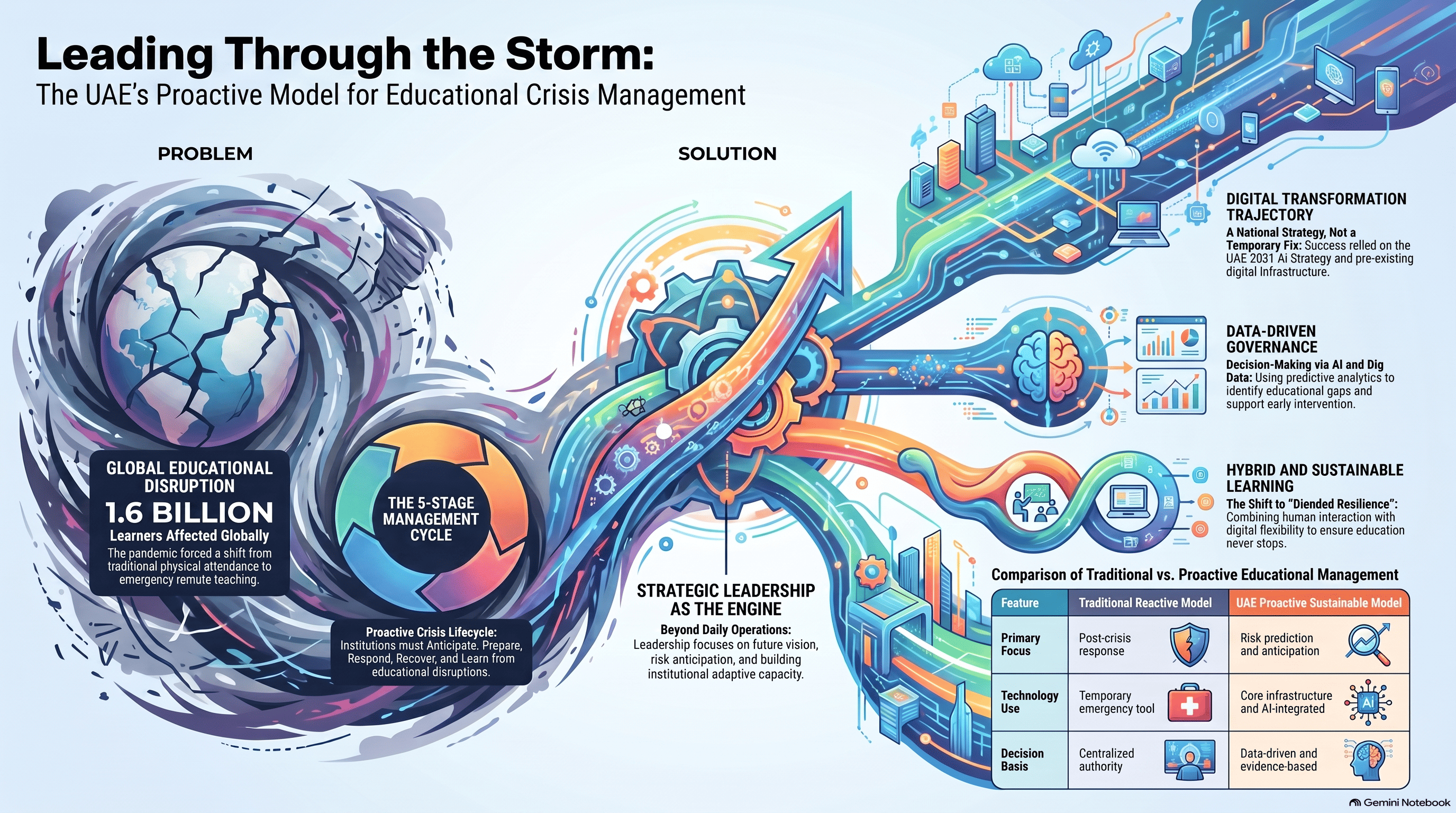
This study examines the role of strategic leadership in enhancing educational crisis management in the United Arab Emirates (UAE), focusing on the COVID-19 experience and the institutional foundations of educational preparedness and continuity. It explores the contribution of digital transformation, artificial intelligence, governance, and risk management to developing a proactive and sustainable crisis-management model. The study adopts descriptive-analytical, inductive, and comparative approaches by reviewing relevant literature, analyzing the UAE experience, and comparing it with Finland and Singapore. The findings indicate that the UAE’s effective crisis response was associated with the integration of strategic leadership, digital readiness, institutional governance, coordination, and human-capital development. They also show that digital transformation reflected a broader national trajectory rather than a temporary response to the pandemic. The study proposes a proactive and sustainable model integrating strategic leadership, risk management, digital transformation, artificial intelligence, governance, and human capital to strengthen educational institutions’ capacity to anticipate, prepare for, respond to, recover from, and learn from crises.
الملخص
يهدف البحث إلى تحليل دور القيادة الاستراتيجية في تعزيز إدارة الأزمات التعليمية في دولة الإمارات العربية المتحدة، من خلال دراسة تجربة جائحة كورونا، وتحليل الجاهزية المؤسسية واستمرارية التعليم، ودور التحول الرقمي والذكاء الاصطناعي والحوكمة وإدارة المخاطر في بناء نموذج استباقي مستدام. اعتمد البحث المنهج الوصفي التحليلي، إلى جانب المنهجين الاستقرائي والمقارن، من خلال تحليل الدراسات والتجربة الإماراتية ومقارنتها بتجربتي فنلندا وسنغافورة. وتبين النتائج أن فاعلية الاستجابة الإماراتية ارتبطت بتكامل القيادة الاستراتيجية والجاهزية الرقمية والحوكمة والتنسيق المؤسسي والاستثمار في رأس المال البشري، وأن التحول الرقمي كان امتدادًا لمسار وطني سابق، وليس استجابة مؤقتة للجائحة. ويقترح البحث نموذجًا استباقيًا مستدامًا يقوم على تكامل القيادة الاستراتيجية وإدارة المخاطر والتحول الرقمي والذكاء الاصطناعي والحوكمة ورأس المال البشري، بما يعزز قدرة المؤسسات التعليمية على التنبؤ بالأزمات والاستعداد لها والاستجابة والتعافي والتعلم المؤسسي.
Downloads
References
Al-Juhani, N. A. (2018). Dawr al-qiyadat al-istratijiyyah fi bina’ al-munazzamat al-mustadamah [The role of strategic leadership in building sustainable organizations]. Arab Organization for Administrative Development.
’Awwad, A. M. (2012). Al-idarah al-istratijiyyah: Mafahim wa namadhij tatbiqiyyah [Strategic management: Applied concepts and models]. Dar al-Masirah for Publishing and Distribution.
’Awwad, A. M., et al. (2016). Al-idarah al-istratijiyyah: Madkhal mu’asir [Strategic management: A contemporary approach]. Dar al-Masirah for Publishing and Distribution.
Bass, B. M. (1985). Leadership and performance beyond expectations. Free Press.
Boin, A., ’t Hart, P., Stern, E., & Sundelius, B. (2017). The politics of crisis management: Public leadership under pressure (2nd ed.). Cambridge University Press.
Bryson, J. M. (2018). Strategic planning for public and nonprofit organizations. Jossey-Bass.
Burns, J. M. (1978). Leadership. Harper & Row.
Comfort, L. K., Sungu, Y., Johnson, D., & Dunn, M. (2001). Complex systems in crisis: Anticipation and resilience in dynamic environments. Journal of Contingencies and Crisis Management, 9(3), 144–158. https://doi.org/10.1111/1468-5973.00164
Daft, R. L. (2016). Management (12th ed.). Cengage Learning.
Dhawan, S. (2020). Online learning: A panacea in the time of COVID-19 crisis. Journal of Educational Technology Systems, 49(1), 5–22. https://doi.org/10.1177/0047239520934018
Government of the United Arab Emirates. (2018). UAE strategy for artificial intelligence 2031. Government of the United Arab Emirates.
Hitt, M. A., Arregle, J.-L., & Holmes, R. M. (2020). Strategic management theory in a post-pandemic and post-crisis world. Journal of Management Studies.
Hitt, M. A., Ireland, R. D., & Hoskisson, R. E. (2020). Strategic management: Competitiveness and globalization: Concepts and cases. Cengage Learning.
Hodges, C., Moore, S., Lockee, B., Trust, T., & Bond, A. (2020). The difference between emergency remote teaching and online learning. EDUCAUSE Review.
Hwang, G.-J. (2014). Definition, framework and research issues of smart learning environments—A context-aware ubiquitous learning perspective. Smart Learning Environments, 1, Article 4. https://doi.org/10.1186/s40561-014-0004-5
Isma’il, ’A. F. M., & Al-Rashidi, A. ’A. M. (2022). Dawr al-qiyadah al-mustadamah fi tahsin al-ada’ al-mu’assasi [The role of sustainable leadership in improving institutional performance]. Scientific Journal of Financial and Administrative Studies.
Kaplan, R. S., & Norton, D. P. (2008). The execution premium: Linking strategy to operations for competitive advantage. Harvard Business School Press.
Kapucu, N., & Garayev, V. (2011). Collaborative decision-making in emergency and crisis management. International Journal of Public Administration, 34(6), 366–375. https://doi.org/10.1080/01900692.2011.561477
Miles, I., Saritas, O., & Sokolov, A. (2016). Foresight for science, technology and innovation. Springer.
Moore, J. L., Dickson-Deane, C., & Galyen, K. (2011). E-learning, online learning, and distance learning environments: Are they the same? The Internet and Higher Education, 14(2), 129–135. https://doi.org/10.1016/j.iheduc.2010.10.001
Northouse, P. G. (2019). Leadership: Theory and practice (8th ed.). SAGE Publications.
Organisation for Economic Co-operation and Development. (2020). Education at a glance 2020: OECD indicators. OECD Publishing. https://doi.org/10.1787/69096873-en
Organisation for Economic Co-operation and Development. (2021). Education at a glance 2021: OECD indicators. OECD Publishing. https://doi.org/10.1787/b35a14e5-en
Quong, T., & Walker, A. (2020). Seven principles of strategic leadership. International Studies in Educational Administration.
Reimers, F. M., & Schleicher, A. (2020). A framework to guide an education response to the COVID-19 pandemic of 2020. OECD.
Robbins, S. P., & Coulter, M. (2018). Management. Pearson.
Trust, T., & Whalen, J. (2020). Should teachers be trained in emergency remote teaching? Lessons learned from the COVID-19 pandemic. Journal of Technology and Teacher Education, 28(2), 189–199.
UNESCO. (2012). Education for all global monitoring report 2012: Youth and skills—Putting education to work. UNESCO.
UNESCO. (2020). Education: From disruption to recovery. UNESCO.
World Bank. (2021). Acting now to protect the human capital of our children: The costs of and response to COVID-19 pandemic’s impact on the education sector in Latin America and the Caribbean. World Bank.
World Health Organization. (2020, March 11). WHO Director-General’s opening remarks at the media briefing on COVID-19—11 March 2020. World Health Organisation.
Yukl, G. (2013). Leadership in organizations (8th ed.). Pearson Education.
Downloads
Published
Issue
Section
License
Copyright (c) 2026 Maktoum Juma Al-Matrooshi

This work is licensed under a Creative Commons Attribution-NonCommercial 4.0 International License.